The United States of America is celebrating the 250th anniversary of its declaration of independence from Britain in 1776.
The key associations with England are mainly to be found along the River Thames.
The most obvious link that comes to mind is the Pilgrims Fathers since the 400th anniversary of the Mayflower setting sail from London was only recently marked. It’s difficult to describe it as having been a celebration since the anniversary fell during Covid. However, there was a ceremony on the river at Rotherhithe and on the Palace of Westminster terrace.
The Mayflower pub on Rotherhithe’s riverside is old and, although largely rebuilt, claims links with the Mayflower crew.
The ship left its home port of Rotherhithe in 1620 for America but probably picked most of its passengers downstream. The captain Christopher Jones is buried in Rotherhithe churchyard.
The first mate John Clark, also from Rotherhithe, has given his name to Clark’s Island in Massachusetts.
The charters creating the first two American colonies had been signed a little earlier at Greenwich Palace by James I who was in residence there in 1607 and again in 1620 when agreeing the charters of Virginia and Massachusetts. As a result there was a court ruling that the American colonies were technically in the Manor Greenwich and so represented at Westminster by the local MPs.
Putney Church, where the Thames Path runs round its south side, is known for the Putney Debates which took place there in 1647 and later influenced the drafting of the US Constitution.
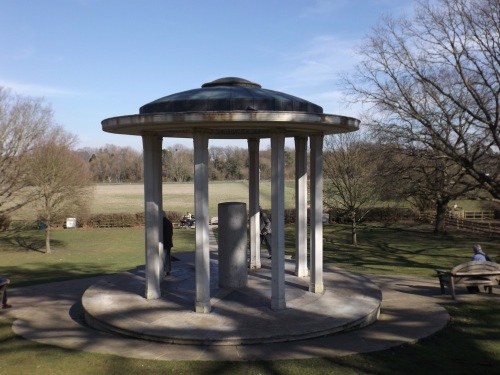
Another influence was Magna Carta which King John assented to in 1215 on Runnymede water meadow by the River Thames.
The site is marked by a memorial erected by the American Bar Association which is returning to London for its annual conference this year. The programme includes a visit to Runnymede.
Nearby is something even more extraordinary: a piece of land which has been declared as ‘American soil’ in memory of President Kennedy.
Sir William Blackstone lived at Wallingford next to the landmark St Peter’s with its candle snuffer steeple. His definitive book Commentaries On The Laws Of England is the source of common law for USA.
Just before this time, in 1737, Richmond in Virginia was given its name by lawyer William Byrd who was reminded of the view of the Thames from Richmond Hill when seeing the bend in the James River.
The divisions during the aftermath of the 1776 declaration can be seen in St Mary’s Battersea where the Thames Path runs through the churchyard. The church has a window commemorating military officer Benedict Arnold who in 1780 switched from the American to the British side. He is buried in the church whilst his name lives on in America as an idiom for a traitor. The window was created in friendship and paid for by an American.
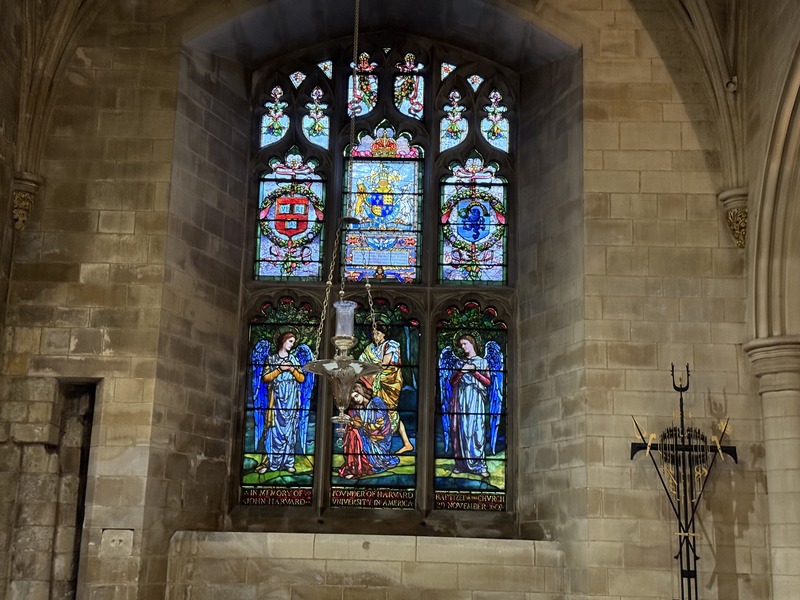
For Harvard graduates the place with the greatest resonance is riverside Southwark Cathedral. John Harvard, whose father was a butcher in Borough High Street, was baptised there in 1607. Its Harvard Chapel is in one of the oldest parts of the church.
The chapel’s east window is by American John Farge and donated in 1907 by the US ambassador who declared: ‘We reiterate the hope that all Harvard men will come to the rock from which they were hewn and to the hole of the pit from which they were rigged to the place where the founder of this great University spent much of his youth, and so add more links which bind this old country with the new.’